


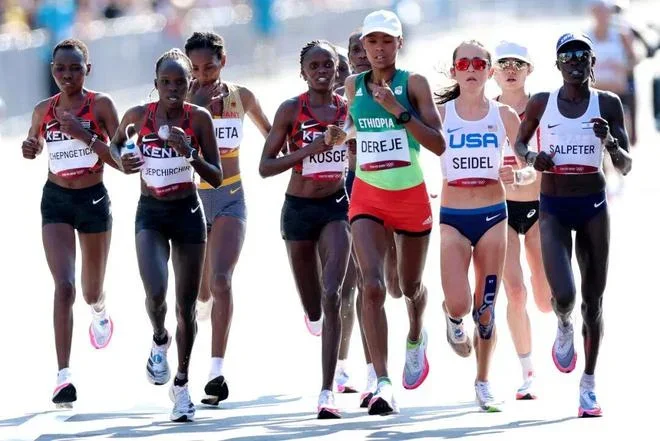
On August 7, 2021, at 6 a.m., the women’s marathon at the Tokyo Olympics began in Sapporo. The asphalt shimmered with heat, and 25 degrees Celsius felt extreme for Hokkaido. After 30 kilometers, the leading pack had shrunk from over 80 runners to fewer than 10. Kenyan star Ruth Chepngetich withdrew, Brigid Kosgei was the favorite, and American Molly Seidel’s lips were turning pale. At 37 kilometers, Israel’s Lonah Chemtai Salpeter stopped abruptly, walked off the course, and stood like a statue.
But Peres Jepchirchir kept running.
Her stride looked heavy in the heat, but in the final kilometer, as she and Kosgei rounded the bend at Odori Park, something ancient surged into her muscle memory—not interval training from a plan, not pacing strategy from a coach’s manual, but the memory of a eight-year-old girl running ten kilometers each day on muddy village paths, and the instinct to run so she wouldn’t be late for school, born from losing her mother.
She accelerated. Kosgei couldn’t follow.
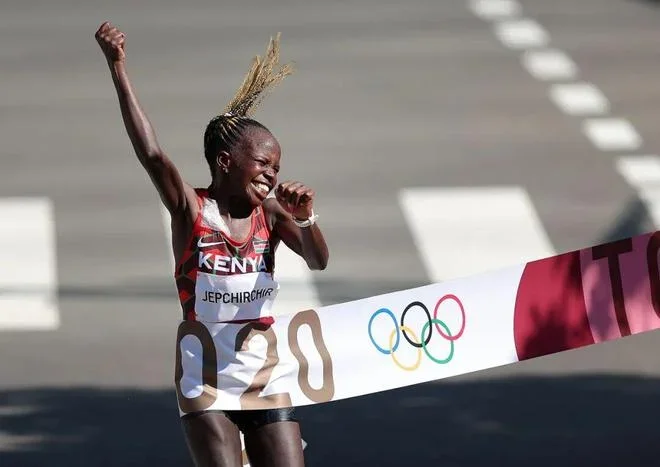
2 hours, 27 minutes, 20 seconds. Olympic marathon champion.
At the finish line, Jepchirchir didn’t collapse immediately. She turned and searched the crowd until she found her three-year-old daughter, Natalia, held in her father’s arms, cheeks flushed with excitement. The little girl waved and shouted in a mix of Swahili and English.
Later, reporters asked what Natalia said. Jepchirchir smiled: “She yelled, ‘Mum, you can do it! Mum, you won!'”
This was the end of the Tokyo Olympic women’s marathon, but also the beginning of a story about motherhood that the world would finally hear.
Rewind to 1993, in a remote farm in western Kenya. No one would have believed that a baby girl born in a mud-and-thatch hut would one day stand at the pinnacle of human endurance sports.
Jepchirchir’s family structure from birth defined her childhood scarcity. Her father had three wives; she was the second wife’s child, one of 24 siblings.
Twenty-four children seems absurd today, but on the highlands of western Kenya, between tea fields and cornfields, it’s just another unit of poverty.
When she was two, her mother died. Jepchirchir has almost no concrete memory of her mother—no hugs, no lullabies, only an increasingly blurry silhouette and an emptiness that could never be filled. Then her uncle, David Barno, took her in.
She later shared a detail: every day she walked five kilometers to primary school. Because she ran fast, when her uncle tried to catch her to scold her for misbehaving, he couldn’t keep up. There’s a cruel romance in this detail: a child who lost her mother used running as a way to escape punishment on Kenya’s red dirt roads, unaware that fate was using this most primitive method to pave a path to the world.
But first, fate gave her another path: dropping out of school. In the third year of junior high, she couldn’t afford tuition and had to leave. She once dreamed of becoming a nurse or a police officer—”respectable” and “stable” jobs for rural Kenyan women. But sport never asks if you have tuition money; it only asks if your legs have fire.
In 2013, at 20, Jepchirchir ran her first marathon in Kisumu, Kenya’s third-largest city. Time: 2:47:33. Unremarkable for professional marathoners, but for a girl who had run through mud for more than a decade, it meant a door opening. That same year, she finished second in a national cross-country race. The winner was a girl named Faith Kipyegon, who would later win three Olympic 1500m gold medals.
In 2015, Jepchirchir married. Her husband wasn’t a traditional spouse—he became her training planner, pacer, logistics manager, and mental coach. In Kenya’s running circles, marriage often ends female athletes’ careers, as culture expects them to focus on “wifely duties.” But her husband seemed to understand from the start that his wife wasn’t an ordinary Kenyan woman; she carried a storm inside that needed release.
One February morning in 2017, on the smooth, pristine track of Ras Al Khaimah in the UAE, Jepchirchir stood at the start line of a half marathon. Nobody knew she was carrying a miracle inside—she was several weeks pregnant.
1 hour, 5 minutes, 6 seconds. A new half marathon world record. Seven months later, in October 2017, daughter Natalia was born.
Sports history has countless “impossible” moments, but this one is uniquely layered. A woman in early pregnancy breaking a world record—it redefines human potential and answers the question of whether “mother” and “athlete” can coexist. Jepchirchir rarely mentions it, as if it were just a task completed in her training plan. But in Kenya’s athletics culture, still dominated by patriarchal structures, a pregnant woman continuing to compete fights more than physical discomfort.
Postpartum return came faster than anyone expected, and harder than anyone imagined. When Natalia was 14 months old, Jepchirchir returned to competition. “Losing weight was tough,” she recalled years later. “Sleep became difficult. When you want to train early, she wakes up. When the child is sick, you feel helpless. You don’t even know which doctor to take her to.”
Kenya’s elite runners train mostly in the high-altitude towns of Iten and Kapsabet, perched on the edge of the Great Rift Valley at over 2,400 meters. The training schedule is rigid and merciless: two sessions daily—long runs in the morning, interval training in the afternoon, interspersed with recovery, massage, and nutrition.
But a mother’s schedule has no “recovery” option. While other athletes napped, Jepchirchir changed Natalia’s diapers; while teammates did core training in the evening, she put her daughter to sleep; while the training camp slept deeply to recover for the next day, she might sit in a clinic hallway holding a feverish child.
“When I compete away from home, I’m always restless,” she said. “You never know if the child is healthy.” But Natalia also gave her something unprecedented. “Becoming a mother made me a better athlete. Because I know someone is watching me, depending on me.”
That dependence isn’t a burden—it’s fuel.
When you hit the “wall” at 35 kilometers, legs like lead, lungs burning, what comes to mind isn’t national glory or prize money, but a three-year-old’s soft voice saying, “Mum, you’ll win!” That power hits directly, stronger than any energy gel.
October 2020, Gdynia, Poland. World Half Marathon Championships. Jepchirchir set a pure women’s half marathon world record (no male pacemakers) of 1:05:16. Three years after Natalia’s birth, two years after returning to top competition.
On the surface, this seems like a standard “postpartum comeback success story.” But for many female athletes, especially Kenyan marathoners, it’s not because they lack the physical ability to recover postpartum—it’s because society’s cracks don’t provide support to catch the falling pieces. Fortunately, Jepchirchir’s husband gave her immense support.
Three months later, December 2020, Valencia Marathon. Jepchirchir’s first truly high-level full marathon: 2:17:43. This time put her directly into Kenya’s Olympic selection pool.
Then came Tokyo, August 2021, the heat, the gold. In November, the New York City Marathon: 2:22:39. She became the first woman ever to win both the Olympic marathon and New York City Marathon
